|
-
Jordan
Investment Board
-
10
reasons to invest in Jordan
-
Aqaba
Special Economic Zone
-
Jordan
– EU Association Agreement
-
US
- Jordan Free Trade Agreement
-
Privatisation
-
The
Qualifying Industrial Zones (QIZs)
-
Information
Technology
-
Cost
of Doing Business in Jordan
-
Jordan
Market Profile
-
Main
Economic Indicators
|
King & Queen paid a State Visit to Sweden
Their Majesties King Abdullah II and Queen Rania
Al-Abdullah paid a State Visit to Sweden from 7-9 October 2003, where they
met with Their Majesties King Carl XVI Gustaf and Queen Silvia. During the
three-day State visit, His Majesty held talks with the Swedish Prime
Minister Göran Persson and Swedish Speaker of Parliament Björn von Sydow. The King's talks focused on development of
cooperation between Jordan and Sweden in numerous fields, particularly the
economic cooperation, in addition to the development of situation in the
Middle East. During his talks with Swedish Prime Minister, His Majesty
reviewed investment opportunities in Jordan for Swedish investors. He
pointed out that the Jordanian European partnership agreement supports the
private sector in Jordan and Sweden for joint ventures.
 Seeking to attract Swedish investments to
Jordan, His Majesty met with members of the Swedish Trade Council that
includes numerous board heads of companies. At the meeting, which was
attended by King Carl XVI Gustaf and Crown Princess Victoria, King
Abdullah reviewed the investment climate in Jordan, voicing hope that his
visit to Sweden would mark a strong launch for economic and investment
relations between the two countries. Seeking to attract Swedish investments to
Jordan, His Majesty met with members of the Swedish Trade Council that
includes numerous board heads of companies. At the meeting, which was
attended by King Carl XVI Gustaf and Crown Princess Victoria, King
Abdullah reviewed the investment climate in Jordan, voicing hope that his
visit to Sweden would mark a strong launch for economic and investment
relations between the two countries.
The King noted that Jordan way is now considered as a
major gateway for international companies interested in investment in the
Iraqi market. He also highlighted the Kingdom's achievements for the past
few years to establish an investment environment based on modern
legislations and international economy.
King Abdullah presented the key executives with an
overview of investment opportunities available in the Kingdom's water,
energy and infrastructure sectors. Several representatives of Swedish big
businesses expressed interest in cooperation with Jordan. Ericsson's top
representative Mr. Antoine Nehme noted in the meeting that his company,
which started its operations in Jordan in 1983, has increased its
activities in the Kingdom in the past four years. He praised the quality
of Jordanian employees in his company, not only in Jordan, he said, but in
the Middle East in general. He also commended King Abdullah’s efforts to
introduce IT to schools, adding that Jordan is moving fast ahead in
communications and information technologies.
King Abdullah and Her Majesty Queen Rania, escorted
by the Swedish Royal couple, King Gustaf and Queen Sylvia, paid a visit to
Ericsson, which takes up 47% of the Middle East market. The King also
visited AstraZeneca, which is one of the five top pharmaceutical producers
in the world.
The King and the Queen and their hosts visited the
Islamic Centre in Stockholm. King Abdullah said that coexistence between
Muslims and Christians in Sweden sets a model for relationships between
human beings.
His Majesty King Abdullah, accompanied by King
Gustaf of Sweden, visited an iron mine in the city, which is one of the
largest mines in the world. To be acquainted with the Swedish experience
in the field of space, Their Majesties visited also the Swedish Institute
for Space Researches, which is one of the specialized institutions
concerning space researches.
WEF: Jordan is advancers in economic
competitiveness
 Jordan
was the Middle East’s most praised nations for economic competitiveness
in the World Economic Forum (WEF)’s newly released international report.
Jordan was commended for making significant advancements in the quality of
its public institutions in the forum’s Global Competitiveness Report
2003-2004. Jordan
was the Middle East’s most praised nations for economic competitiveness
in the World Economic Forum (WEF)’s newly released international report.
Jordan was commended for making significant advancements in the quality of
its public institutions in the forum’s Global Competitiveness Report
2003-2004.
Jordan showed the largest score and rank increase in
the area of public establishments, driven by gains in control of
corruption and greater independence of the judiciary, said the report. The
country also posted better ratings relating to public trust in
politicians, diversion of public funds, and the extent of distortive
subsidies.
The survey’s Growth Competitiveness Index (GCI)
aims to analyse the potential of the world’s economies to attain
sustained economic growth over the medium and long term. The index is
founded on three central components: the macroeconomic environment, the
quality of public institutions, and technology.
WEF’s annual report evaluates the potential for
sustained economic growth of 102 economies and ranks them accordingly.
Jordan ranked 34th this year on the GCI Index, up from 44 in 2002.
King
calls for setting up software federation
His Majesty King Abdullah has called for the
establishment of an Arab regional software federation as part of efforts
to enhance IT cooperation. He said such parties can work “as partners”
to achieve the goals of regional development, technological advancement
and building up integrated resources and initiatives.

The King made the remarks as he received in Dubai the
Arabian Business e-Achievement Award in recognition of his efforts to
boost IT in the region. He was presented the award by HH Sheikh Mohammed
Ben Rashid Al Maktoum, crown prince of Dubai and UAE minister of defense,
at a special ceremony held on the sidelines of Dubai GITEX 2003, IT
exhibition.
The award is offered on an annual basis by the
Information & Technology Publishing Company. The King said he was glad
to receive the award on behalf of all Jordanian IT leaders.
Faisal
Fayez Forms a New Jordanian Cabinet
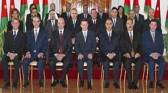 His
Majesty King Abdullah II swore in a new 21-member Cabinet led by Prime
Minister Faisal Fayez on October 25, 2003. The New cabinet grouped former
ministers and new personalities, mainly young technocrats, including an
unprecedented three women.
Dr. Marwan Muasher kept his portfolio as Minister of Foreign Affairs. Click
here to view members of the new Cabinet. His
Majesty King Abdullah II swore in a new 21-member Cabinet led by Prime
Minister Faisal Fayez on October 25, 2003. The New cabinet grouped former
ministers and new personalities, mainly young technocrats, including an
unprecedented three women.
Dr. Marwan Muasher kept his portfolio as Minister of Foreign Affairs. Click
here to view members of the new Cabinet.
King Inaugurates Kemira Arab Potash Company
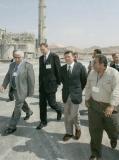 His Majesty King Abdullah II inaugurated Kemira
Arab Potash Company (KEMAPCO), Jordan's largest fertilizers and animal
feed production plant, on October 20th, 2003. The facility,
located in the southern Governorate of Aqaba, is a joint venture by
Jordan's Arab Potash Company, one of the 10 biggest exporters of potash
worldwide, and Finland's Kemira GrowHow, a global chemical industry group. His Majesty King Abdullah II inaugurated Kemira
Arab Potash Company (KEMAPCO), Jordan's largest fertilizers and animal
feed production plant, on October 20th, 2003. The facility,
located in the southern Governorate of Aqaba, is a joint venture by
Jordan's Arab Potash Company, one of the 10 biggest exporters of potash
worldwide, and Finland's Kemira GrowHow, a global chemical industry group.
KEMAPCO's production, which is estimated to reach
150,000 tons of potassium nitrate fertilizer annually, will put Jordan on
the global industrial map as it will be able to contribute 10% of the
total global market's production, estimated at 1.2 million tonnes
annually.
The production of dicalcium phosphate animal feed,
estimated at 75,000 tons per year, will represent almost 1.25% of the
total global annual production, which stands at 6 million tons.
Jordan
& Microsoft sign a deal to enhance IT strategies
Jordan has signed a strategic partnership
agreement with Microsoft to accelerate the development of the information
technology sector, pushing forward the e-government and e-learning
strategies. ICT Minister Fawwaz Zu'bi said the five-year deal will open
the door to several Microsoft investments in the Kingdom. "This
agreement serves Jordan's overall strategy, through the completion of
strategic projects, the promotion of the development of unique
intellectual property jointly with Microsoft, and capacity building across
all segments of society, as well as contributing to revolutionising
education in Jordan," Zu'bi told reporters at the signing ceremony.
|
 SOFEX 2004, 26 – 29
April 2004
SOFEX 2004, 26 – 29
April 2004
|
Under the deal, Microsoft will co-invest in
projects selected jointly with the government from within the national
strategies to bring the educational system online and allow citizens to
obtain government services with the click of a mouse. Also, Microsoft will
supply advanced training to 1,000 engineers, set up and fully equip
electronic libraries for 50,000 children in rural and remote areas,
disclose source codes as part of technology transfer, and establish new IT
academies.
Jordan Economic Forum magnifies
Kingdom's business opportunities
Seven-hundred Arab and foreign businesspeople
gathered in Amman to attend the launch of the Jordan Economic Forum, one
of the largest gatherings of pan-Arab investors this year, with hopes of
attracting investments to the country clearly reflected in officials'
speeches.
Jordan’s Prime Minister Ali Abul Ragheb, who
participated in the opening ceremony alongside Lebanese Premier Rafiq
Hariri, was first to give the investment pitch to the high-profile
audience, underlining improvements made by the local economy and the
different economic, political and social reforms implemented during the
past few years.
“Despite a general economic growth slowdown in
nearby countries, the Jordanian economy has shown marked progress in
different economic sectors with a real growth rate of 5%
registered by the end of 2002,” Abul Ragheb told dignitaries and
investors from 28 different countries attending the ceremony. He said
efforts were made to improve the private sector's participation in
economic development through new and transparent legislation and embarking
on a privatization scheme of state-owned companies as well as launching
key national projects wherein both local and foreign business communities
could invest. “It is imperative we increase cooperation between the
different economic stakeholders in Arab countries by paving the way for
the Arab private sector to assume a more vital role in opening new markets
for globally competitive products,” the prime minister explained.
 HRH Prince Faisal, the Regent, deputizing for
His Majesty King Abdullah, attended the opening ceremony, organized by the
Beirut-based Al Iktissad Wal Aamal Group along with several Arab and local
dignitaries and ministers. HRH Prince Faisal, the Regent, deputizing for
His Majesty King Abdullah, attended the opening ceremony, organized by the
Beirut-based Al Iktissad Wal Aamal Group along with several Arab and local
dignitaries and ministers.
Six Iraqi ministers heading a large business
delegation have also attended the forum to explore opportunities for
cooperation between Arab and foreign companies in the reconstruction of
Iraq.
Al Iktissad Wal Aamal's general manager, Raouf Abu
Zaki, also took the podium commending the vast steps Jordan took towards
opening its economy through various partnerships and agreements with
global players. He also predicted a prominent role for Jordan as a hub for
investment in the region and a gateway for future business prospects in
Iraq.
IFC's Middle East and North Africa Director agreed
with Abu Zaki, recalling the success stories of the pharmaceutical and
medical services sectors of the economy encouraging more attention to the
employment-dense services sector as a means for investing in Jordan's
human capital. He also urged the Iraqi private sector to follow suit and
take the lead in bringing Iraq back on the global scene.
Foreign
trade grows 10% in eight months
While instability in Iraq and Palestine continues to
cast shadow on the economies of the region, the country's foreign trade
figures show a 10.1% growth during the first eight months of this year
compared to the same period last year, according to the Ministry of
Industry and Trade (MoIT) monthly bulletin.
The growth is attributed to a 4.2% rise in domestic
exports, a 10.5% increase in re-exports and a 12.5% jump in imports. A
statement from the ministry credited the steady rise in foreign trade,
particularly exports, during the past few years to the "success of
Jordan's comprehensive economic reform programmes….trade liberalization
and full integration in the global economy."
The JD41.6 million ($58.1 million) rise in domestic
exports from January until August this year was due to a 41.2% growth in
textile industry exports measured against the same period last year.
Substantial growth in unconventional industry exports, such as natural or
cultured pearls and precious and semi-precious stone as well as beverages
and vinegar beefed up exports by 144.4% and 211.1% respective increase
over the first eight months of 2002.
Domestic exports from Qualified Industrial Zones (QIZ),
however, grabbed a considerable share of the country's total exports
reaching JD261.8 million ($366.1 million) by the end of August this year
and registering a JD101.7 million ($142.2 million) increase over the same
period last year or a 63.6% growth.
AJEX pushes investors to seize
the opportunity, penetrate Iraqi market.
Hundreds of national, regional and international
participants representing private and public sectors attended the
American Jordanian Expo, AJEX 2003,
which was held from 22 to 23 October, 2003 with the reconstruction of Iraq
under the spotlight.

Held under the patronage of His Majesty King
Abdullah II, the two-day conference provided businesspeople with the
opportunity to tap into the lucrative market in Iraq, network with other
potential investors as well as get a firsthand look at the experiences of
the US-led coalition ruling Baghdad. Also highlighting Jordan as an
investors' hub in the region underlined the importance of the Kingdom as
the gateway for business in Iraq.
Viewed by entrepreneurs and economists alike as model
in the region in terms of its bilateral trade agreements that include the
Free Trade Agreement (FTA) with the US and other ties with the European
union and the WTO, Jordan strives to build the capacity of its wealth of
human resources while building the capacity of private and public sector
partnerships.
Molly Williamson, deputy assistant secretary for
Africa, Middle East and South Asia at the International Trade
Administration/US Department of Commerce, told the participants that while
other countries in the region have been suffering from economic slowdown,
Jordan has been enjoying tremendous economic prosperity. In 1998, the
Kingdom's exports stood at a mere $12 million in comparison with an
expected $350 million by the end of the year. This growth represents a
300% increase during the last three years. Furthermore, exports from the
Qualified Industrial Zones are now valued at $500 million.
Local as well as key speakers representing the
Coalition Provisional Authority (CPA), and other state officials from the
UK and the US, all called on investors to seize the opportunity and
penetrate the Iraqi market capitalising at the same time on new
legislation to encourage foreign investment.
Business
Scene:
- Amman, Zarqa and Irbid account for most of the economic activity in
the Kingdom
The registration of 68,838 companies in the capital Amman between
January and August 2003 placed Amman at the top of the Kingdom's 12
governorates in terms of economic activity. According to figures from the
Ministry of Industry and Trade, Zarqa came second by a far margin, as
6,869 companies were registered, or about 10% of the Amman's total firms.
Irbid ranked third with 5,406 companies registered during the first eight
months of this year.
- Tourists to get sales tax refund starting 2004
The Ministry
of Finance has signed an agreement with a French firm under which the
government will refund sales tax to tourists and non-residents who buy
goods in the Kingdom for export. Under the deal, France's Premier Tax Free
will refund tourists between JD50 ($70) and JD500 ($700) for products
bought in Jordan. The firm's general manager in Jordan said that the
scheme will start at the beginning of 2004.
- Jordan assumes posts in WTO Executive Council, Middle East
Commission
Jordan was
elected vice chairman of the Executive Council and vice chairman of the
Middle East Commission of the World Tourism Organisation (WTO), at its
recently concluded 15th General Assembly in Beijing. Jordan is a founding
member of the World Tourism Organisation, which held its first General
Assembly in Madrid in May 1975.
Featured
Article:
The
Road to Aqaba: Journeying through the Golden Tourism Triangle is a true
voyage through time
When the
sun sets on Aqaba after a long day of trekking the vast desert of Wadi Rum
or stroking the stones and pebbles of the truly breathtaking Nabataean
city of Petra, the golden rays revisit the footprints and paths trodden by
long-gone caravans manned by daring merchants, whose compass were the
stars at night and the visions of water, as camels and horses swooned,
during daytime.
Dazzling in its simplicity, the pristine desert and sand dunes of Wadi Rum
could only be matched by the red-rose hues of one of the ancient world's
true wonders, Petra, and the dazzling coastline of Aqaba, tucked neatly in
the center of this cultural fiesta, with its evocative blue waters dancing
majestically at the northern tip of the Red Sea.
Sewn together by the thread of historic travelers, whose canvas was the
desert and their map the sky, the Golden Tourism Triangle stands as
whiteness to the cultural and mystical heritage of the jeweled city of
Aqaba, nestling on an ancient caravan route upon which luxurious cargos of
gold, perfumes and fine silks passed, after crossing deserts upon deserts
as well as man-carved temples hiding within the folds of the "the
pearl of the desert," Petra.

Today, the waves caress 27 kilometers of Aqaba's coastline, strewn with
five-star hotels and resorts that bring you services and offers to
rejuvenate the soul and mind after a long journey through the paths and
passageways of Petra city, a declared UNESCO World Heritage Site since
1985. Passing through the exceptional deserts of Wadi Rum, campers can
still listen to echoing ballads and myths about Lawrence of Arabia, whose
footsteps can be vividly heard crunching against gravel that adorns the
natural canyons cutting through mountains, such as Um Ishrine (Mother of
Twenty) and Khazali, where a unique flower to Jordan thrives.
The desert road to the Aqaba
Special Economic Zone (ASEZ), 324 kilometers away from Amman
the capital, could be a true journey through Jordan's remote villages and
towns where a taste of our people's warmth and hospitability can be
savored. But what truly is worth navigating through remains one of two
roads that lead to Aqaba, through the dramatic lows of the Dead Sea basin
(the Wadi Araba highway), where the Baptism site religiously sits at the
mouth of this largest salty lake in the world and lowest point on earth,
with a string of first-class resorts dotting the shoreline. Or you can
simply take a one-hour flight from Amman to land after a pleasant trip at
the Aqaba Airport, where duty-free items include a handful of artifacts
and masterfully knitted embroidery and souvenirs, carefully selected to
reflect the treasures of Jordan.
Covering an approximate 375 square kilometers of land, ASEZ encompasses a
spree of sites where religion, mythology, art, nature and culture melt in
a locality that enjoys a climate matchless in the region as temperatures
usually stay at no less than 25 degrees Celsius, while water temperatures
changing between 18 to 27 degrees Celsius year round are perfect for
diving, skiing and other exciting water sports.
Plan your next vacation to be a truly memorable lifetime experience and
make your destination this undeniably regional tourism hub, the very
Golden Tourism Triangle, where bridging the ancient and the modern worlds
is our people's craft. To know more about ASEZ, visit www.aqabazone.com
and without hesitance do drop us a line via the website's Guest Book to
tell us more about your family journey, eco-tourism adventure or religious
pilgrimage.
For further information contact Ms. Ruba Saqr, Communication Officer at
ASEZA. Email: [email protected]
or [email protected]
Jordan
at Glance
Ruling
Regime:
Constitutional
monarchy with representative government, freely elected
parliament and independent Judiciary.
Location:
Jordan
is situated between latitudes 29 and 33 north and longitudes 34
and 39 east.
Population:
Estimated at 5.33 million inhabitants in 2002.
Area:
89.300
square km, of which 7.8 % is agricultural land.
Climate:
Hot and dry in summer, rainy in winter.
Timing:
Two hours and three hours ahead of Greenwich timing, in
winter and summer respectively.
Language:
Arabic,
English is widely spoken particularly in business.
Economic
System:
Market
oriented economy.
Size
of Economy:
GDP
in 2002 is estimated at JD 6591 million or US$ 9296 million.
Standard
of Living:
Per
capita GDP at current market prices equals JD 1237 or US$ 1745
in 2002.
Currency:
Jordan
Dinar, which equals US$ 1.41, is fully convertible.
Resources:
·
Several
natural resources; phosphate and potash are the most important
ones
·
Abundant
skilled human resources and several tourism sights
|
For
further information about doing business in Jordan, you may contact Mr.
Haitham Abu Alfoul at the Embassy, phone +49 30-36 99 6033 fax +49 30-36
99 6011, [email protected].
Large part of the Newsletter is reprinted from the Jordan Times
|